


Gut flora and the brain: how your gut influences your nervous system, emotions, and trauma
The connection between your gut and your brain goes far beyond just diet and digestion. Increasingly, research shows that your gut flora directly influences your mood, your stress levels, and even how safe you feel in your body.
But what is often missing from this explanation is the deeper layer: the role of the nervous system and stored tension or trauma in the body.
In my practice, I see that these three systems—gut, brain, and nervous system—are inextricably linked.
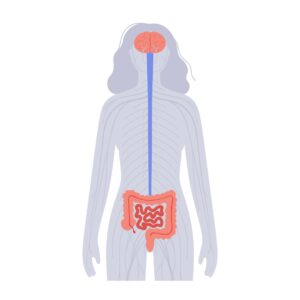
The gut-brain axis: communication between body and brain
Your gut and brain are continuously connected to each other via the so-called gut-brain axis. This communication takes place via:
- the vagus nerve (important for relaxation and recovery)
- hormones and neurotransmitters
- your immune system
Approximately 901 TP3T of serotonin (your “happiness hormone”) is produced in the gut.
This means that a disturbed gut flora can have a direct impact on:
- feelings of anxiety
- mood swings
- inner turmoil
But this is only one part of the story
 The role of the nervous system (where things often go wrong)
Many people focus only on diet or supplements.
But if your nervous system is constantly in a state of stress, your body struggles to recover — not even in your gut.
With prolonged stress or trauma, your body can get stuck in:
- fight or flight mode
- chronic tension
- a feeling of insecurity
This has direct consequences for your intestines:
- reduced digestion
- altered gut flora
- increased inflammatory responses
In other words:
A dysregulated nervous system creates an environment in which the gut flora becomes unbalanced.

 Gut flora and stored emotions
What is often overlooked is that your body stores experiences — not only in your head, but also physically.
The intestines are particularly sensitive to this.
Many clients recognize:
- a knot in the stomach
- tension around the stomach
- sudden bowel problems triggered by stress or triggers
These are not “coincidental” complaints. This is the body reacting to inner tension.
When this tension is present for a prolonged period, this can:
- influence the intestinal wall
- change the composition of bacteria
- reduce the body's recovery capacity
 The key: working on multiple layers
True healing arises when you look at the whole:
1. Regulation of the nervous system
Your body needs to come out of stress mode to recover.
2. Support of the gut flora
With nutrition, rest, and targeted supplementation.
3. Working with stored voltage
So that the body does not keep reacting to old patterns.
 A first step you can take yourself
A simple exercise to support your nervous system:
- Place your hand on your stomach
- Breathe in slowly through your nose
- Make your exhalation longer than your inhalation
- Repeat this for 3–5 minutes
This helps your body experience signals of safety.
which has a direct effect on your intestines
 Finally
The connection between gut flora and the brain is not a standalone system.
It is a collaboration between the body, the nervous system, and emotional processes.
When you understand and support this connection, space is created for true healing — from within.
 Why nutrition alone is often not enough
Healthy eating is important — but it is rarely the complete solution.
If your body does not feel safe, it remains in a state of alert.
And in that state:
- slows down your digestion
- nutrient absorption becomes less efficient
- the body remains focused on survival, not on recovery
That is why you often see people “doing everything right” in terms of diet, but still not feeling better.
🥗 Fermented foods (and gut health)
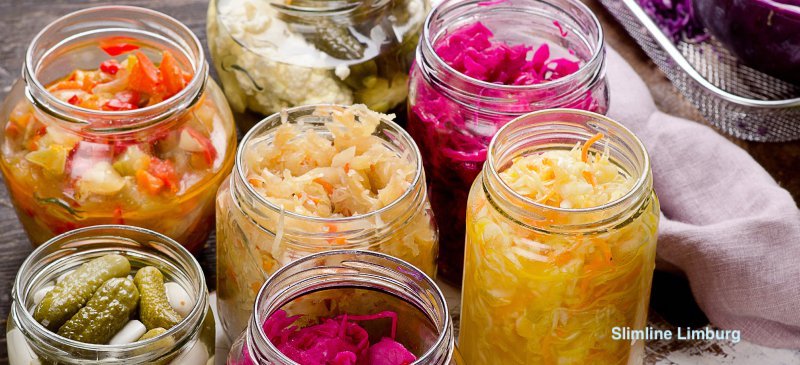
Fermented foods contain natural bacteria that can have a positive influence on the gut flora. These foods support the diversity of microorganisms in the intestines and can contribute to healthy digestion and overall balance in the body.
In addition, fiber from vegetables plays an important role as food for good gut bacteria.
🌿 Vegetables (rich in fiber)
Vegetables form the basis of a healthy gut flora.
They contain fibers that act as food for the good bacteria in the gut, also known as prebiotics.
🌱 Tempeh
Tempeh is made from naturally fermented soybeans. It has a slightly nutty flavor and is a valuable plant-based protein source.
Due to the fermentation process, tempeh contains more absorbable nutrients and is often better tolerated than non-fermented soy.
Moreover, it is rich in essential amino acids and fits well into a vegetarian or plant-based diet.
🍲 Miso
Miso is a fermented paste made from soybeans, rice, or barley. It is known for its deep umami flavor and is often used in soups and sauces.
Due to fermentation, miso contains natural enzymes and bacterial cultures that can support digestion.
🥬 Sauerkraut
Sauerkraut is made from white cabbage and salt, where the fermentation process ensures the formation of probiotic bacteria.
It contains not only probiotics, but also fibers that support gut health.
🥣 Yogurt
Yogurt with “live & active cultures” contains live bacterial cultures that can be beneficial for the gut flora.
Even yogurt without this label can still contain certain bacterial strains, depending on the production process.
Preferably choose unsweetened varieties without additives.
🥛 Kefir
Kefir is a fermented milk drink with a light, fresh taste similar to drinkable yogurt.
It contains a broad spectrum of bacteria and yeasts and is also a source of calcium and protein.
Due to the diversity of microorganisms, kefir is often regarded as one of the most powerful fermented foods.
🍹 Kombucha
Kombucha is a lightly sparkling fermented tea, usually based on black or green tea.
During the fermentation process, probiotic cultures and a slightly sour taste develop. It is often flavored with herbs or fruit.
Please note: due to natural fermentation, kombucha may contain a very small amount of alcohol (usually less than 0.5%).
🌶 Kimchi
Kimchi is the Korean version of sauerkraut and is made from fermented cabbage with herbs and spices.
It is spicy, rich in flavor, and contains natural bacterial cultures that can support the gut flora.
Kimchi can usually be found in the refrigerated section with Asian products or other fermented foods.





1 thought on “Invloed van darmbacteriën op hersenen”
Pingback: Finding yourself again | Finding yourself therapy